Wood Exterior Paint Coating: Why Standard Paint Keeps Failing — And What Actually Works
Category
If you own a wood-sided home in the Chicago area, you already know the cycle. Paint the house, it looks great for a season or two, and then the cracks start. Peeling follows. By year four or five, you’re staring down another repaint — or worse, soft boards that need replacing before you can even think about paint again.
This is especially true for cedar siding homes. Cedar is beautiful, dimensionally stable compared to other species, and widely used across Chicagoland’s older housing stock — but it’s not immune to the punishment Illinois weather delivers. If you’re living in a cedar home and trying to figure out why paint never seems to last, this breakdown of the best approach to cedar and wood exterior painting is worth reading before you make your next move.
The short version: this isn’t a contractor problem or a bad-paint problem. It’s a wood problem — specifically, the way wood moves, breathes, and absorbs moisture in a climate that swings between 95-degree summers and single-digit winters. Understanding why standard paint fails on wood siding is the first step to understanding why a ceramic coating system works where paint doesn’t.
What Actually Happens to Paint on Wood and Cedar Siding
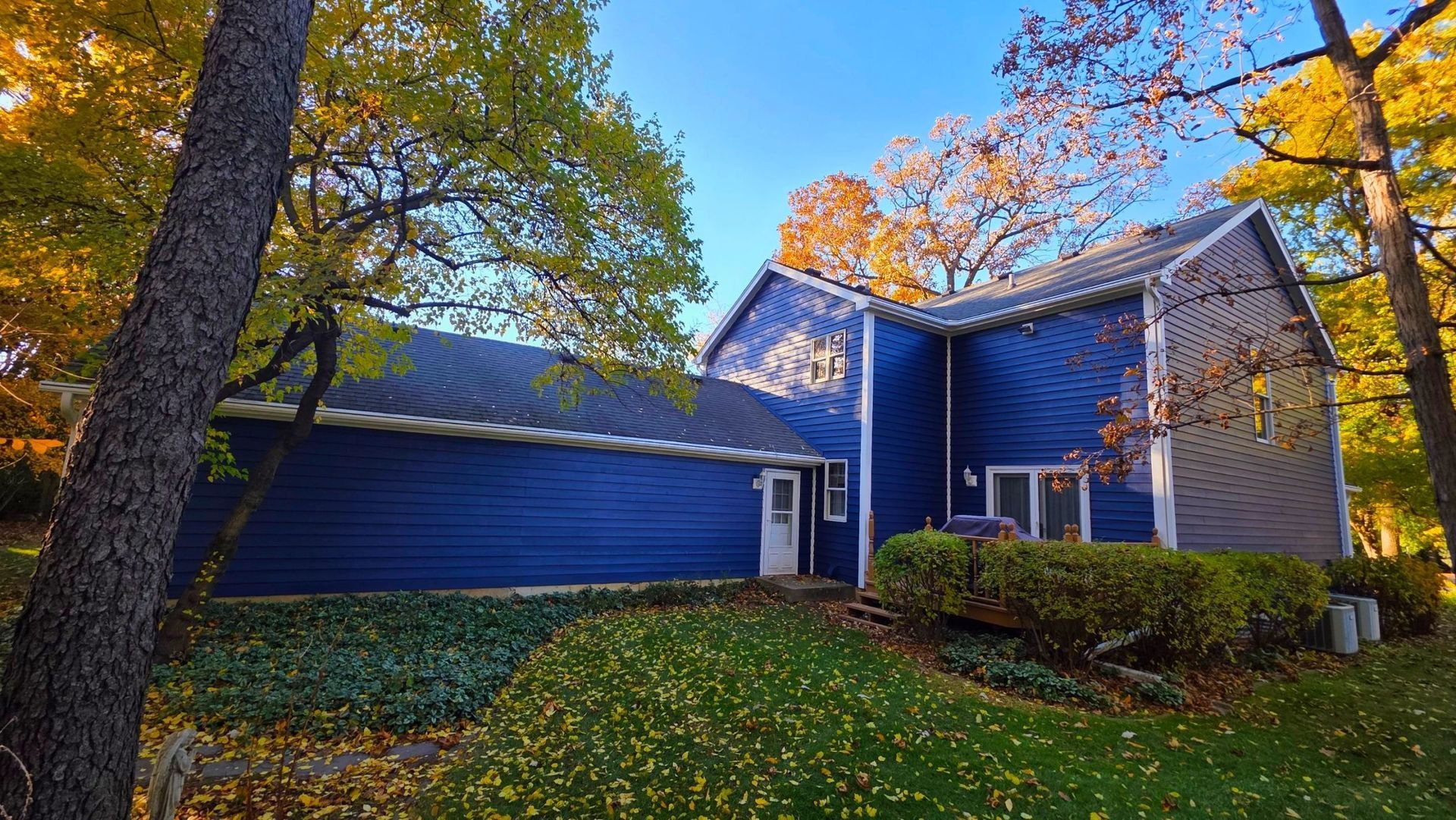 Wood is a living material in a practical sense — it expands when it absorbs moisture and contracts when it dries. Cedar in particular is prized for its relatively low shrinkage, but it still moves. In Chicago, that moisture cycle happens constantly across an entire season and sometimes within a single day as temperature and humidity fluctuate.
Standard exterior paint, no matter how high the quality or how carefully it’s applied, is a rigid film sitting on top of a flexible substrate. Every time the siding moves, the bond between the paint and the wood weakens slightly. Over time, micro-cracks form at the surface. Water gets into those cracks. Wood fibers begin to degrade beneath the paint layer. The paint peels not because it was applied wrong, but because it was never designed to move with the material underneath it.
According to the USDA Forest Products Laboratory, the expansion and contraction of wood with changes in moisture content is one of the primary causes of paint failure on exterior wood surfaces — and the problem compounds in climates with wide temperature swings. This is physics. No amount of premium latex paint fully overcomes it.
Where Wood Siding Fails First on Chicago Homes
Paint doesn’t fail uniformly across a wood-sided exterior. It fails at the stress points — the places where moisture, UV, and temperature cycling hit hardest simultaneously.
- South and west-facing walls , which absorb the most direct sun and UV load, causing paint to chalk and break down faster than shaded elevations
- Window sills and door casings , where horizontal surfaces collect standing water and the wood cycles through repeated wetting and drying
- Lap siding bottom edges , where water is designed to shed but also where the end grain of each board is exposed — end grain absorbs moisture far faster than face grain and degrades first
- The bottom two or three courses of siding , which get continuous splash-back from rain hitting the foundation and have the least air circulation to dry out
- Wood trim at the roofline , where ice dams in winter push water back up under the surface, freezing and expanding against the paint bond from behind
These aren’t random failure points. They’re predictable, and they show up in the same order on almost every wood-sided home in the Chicago area regardless of when it was last painted.
Cedar Siding Specifically: Why It Deserves a Different Conversation
Cedar gets special attention for good reason. It’s used extensively on homes built from the 1950s through the 1990s across Cook, DuPage, Lake, and Kane Counties — and it’s still the material of choice for many custom builds today because of its natural resistance to insects and decay. But cedar’s properties that make it desirable also make it behave differently from other siding materials under a paint system.
Cedar’s natural oils are one of the reasons it resists rot so well — but those same oils can interfere with paint adhesion, particularly as the wood ages and the oils migrate to the surface. This is why cedar siding that paints perfectly in year one can become problematic by year three or four: the chemistry between aging cedar and a film-forming paint changes over time.
Cedar also has a coarser surface texture than engineered wood products, which means paint sits unevenly across the face of each board — thicker in the valleys, thinner on the ridges — creating inconsistent film thickness that develops cracks at different rates across a single piece of siding.
A ceramic elastomeric coating handles both of these issues differently. It’s applied thick enough that surface texture irregularities are filled and leveled rather than just followed. And unlike film-forming paints, it doesn’t rely on the same adhesion chemistry that cedar’s natural oils can undermine.
What a Ceramic-Based Exterior Coating Does Differently
Rhino Shield’s coating system is fundamentally different from paint in how it bonds to wood siding and how it performs over time. Rather than forming a rigid film, the elastomeric ceramic formula remains flexible after curing — it can expand and contract with the wood instead of fighting against it. The result is a coating that doesn’t crack or peel at the seams when the siding moves through seasonal cycles.
The ceramic particles in the coating create a breathable barrier that allows moisture vapor to escape from inside the wood while blocking liquid water from penetrating from the outside. This is the opposite of what film-forming paints do — they trap moisture against the wood, which accelerates rot and paint failure simultaneously. For cedar homes in particular, where moisture management is already complicated by the wood’s natural properties, this breathability difference matters significantly.
The system is also dramatically thicker than standard paint applications — typically 10 to 15 times the dry film thickness of a conventional exterior paint job. That added thickness delivers durability, fade resistance, and the deep color saturation that makes Rhino Shield homes look freshly coated years after the application. On cedar siding with its natural texture, the visual result is particularly striking because the coating settles into the grain in a way paint cannot.
A Real Result: What Customers Notice
Dean Bichler, a recent Rhino Shield of Chicagoland customer, captured the neighborhood reaction plainly:
“From the beginning with Zach, thru the application with Juan and his crew, everything was great. Many complimentary comments from people passing by.”
— Dean Bichler, Rhino Shield of Chicagoland customer
Neighbors stopping to comment is a specific kind of validation. It means the visual result was distinct enough from what a standard paint job delivers that people noticed unprompted. On a wood-sided or cedar home, that difference in depth and finish quality is typically visible from the street.
When Is the Right Time to Switch from Paint to Coating?
If your wood or cedar siding is currently in good condition — no rot, no major delamination, paint still mostly adhering — that’s actually the ideal window to apply a ceramic coating. The prep work is minimal, the surface bonds cleanly, and you get the full protection benefit from day one rather than starting a coating system over compromised wood.
If the siding is already showing early signs of paint failure — chalking, peeling edges, raised grain, soft spots — that doesn’t automatically disqualify it, but it does mean the prep work becomes more involved. Any deteriorated wood needs to be repaired or replaced before coating application. An honest estimate will walk you through exactly what condition the siding is in and what preparation is required before anyone picks up a sprayer.
Homeowners who make the switch typically stop thinking about their exterior entirely — which is the goal. Wood siding properly coated with a ceramic system doesn’t need to be on your radar until the warranty period is long over.
Get a Free Assessment for Your Wood or Cedar Siding
If your home has wood or cedar siding anywhere in the Chicago metro area, a free estimate from Rhino Shield will tell you exactly what condition the siding is in and what preparation it needs before coating. You can also browse our project gallery to see before-and-after results on wood and cedar exteriors similar to yours.
Chicago weather is genuinely hard on wood siding. The coating protecting it needs to outlast the weather — not just survive one season of it.
Frequently Asked Questions: Wood and Cedar Exterior Coating
Why does exterior paint keep peeling off wood and cedar siding?
Wood siding expands and contracts with every change in temperature and humidity. Standard exterior paint forms a rigid film that can’t flex with that movement, so it micro-cracks, lets in water, and eventually peels. Cedar’s natural oils also interfere with paint adhesion over time as the wood ages, making the problem worse with each paint cycle. This is a materials science problem, not a workmanship problem.
What makes ceramic coating better than paint for cedar siding homes?
A ceramic elastomeric coating like Rhino Shield is 10–15 times thicker than standard exterior paint and remains flexible after curing, so it moves with the cedar rather than cracking against it. It’s also vapor-permeable, allowing moisture to escape from within the wood while blocking liquid water from the outside — the opposite of how film-forming paint behaves. And unlike paint, it isn’t undermined by cedar’s natural oils.
How long does a wood exterior coating last in Chicago?
Standard exterior paint on wood siding typically lasts 5–8 years in the Chicago area before needing repainting. Rhino Shield’s ceramic coating system carries a 25-year manufacturer’s warranty. Properly applied to prepared wood or cedar siding, it outlasts multiple conventional paint cycles without peeling, chalking, or significant color fade.
Can ceramic coating be applied to all types of wood siding?
Yes. Rhino Shield’s system works on lap siding, cedar shake, board and batten, tongue and groove, and wood trim and fascia. Any wood exterior surface that can be properly cleaned and prepared is a candidate. Surfaces with active rot or structural damage need repair first — no coating performs well over compromised wood substrate.
Is wood exterior coating worth the higher upfront cost?
Over 25 years, most Chicago homeowners pay for three to five complete exterior paint jobs plus labor, disruption, and the contractor search each time. A ceramic coating system costs more upfront but eliminates those repeat cycles. Total cost of ownership over two to three decades is typically lower with coating, and the home looks consistently better throughout.
What preparation does wood siding need before coating is applied?
Surface preparation for wood siding coating includes pressure washing, scraping any peeling paint, feathering edges, repairing or replacing deteriorated boards, caulking gaps and seams, and priming bare wood. The quality of prep work determines how long the coating performs — it’s 60–70% of what makes the application succeed long-term. A thorough pre-application assessment will identify exactly what your siding needs before work begins.
Does the coating change the look of cedar siding’s natural texture?
No — cedar siding’s natural grain and texture remain visible through the coating, and the ceramic formula actually enhances the visual depth of that texture compared to film-forming paint. Colors appear richer and more saturated because the coating settles into the grain differently than paint. The result typically looks more finished than a standard paint job, not flatter.
Request a free home inspection and estimate today.
The post Wood Exterior Paint Coating: Why Standard Paint Keeps Failing — And What Actually Works appeared first on Rhino Shield of Chicagoland.